Financial Requirements for a U.S. Tourist Visa: What B1/B2 Applicants Should Know
One of the most common questions about the U.S. B1/B2 visitor visa is how much money you need in the bank. There is no official figure, and anyone quoting one is guessing. What the consular officer actually needs to see is that you can reasonably cover your trip and that you are unlikely to become dependent on U.S. public support while you are there.
Last updated: 5 September 2026. Guidance on public benefits and visa eligibility has changed more than once — confirm the current position on the official source linked at the end before you rely on any summary, including this one.
What “public charge” means
“Public charge” is the idea that a visitor should support themselves rather than rely on government assistance. For a temporary visitor it is straightforward in principle: your trip should be paid for by you, or by someone credible who has agreed to pay for it. The officer is not looking for wealth. They are looking for a plan that adds up.
There is a second, separate consequence. Improperly claiming certain U.S. public benefits can affect your current visa and your future eligibility — a visa can be revoked, and later applications can be refused. This matters mainly to people who have already spent time in the United States, and it is a reason to be careful about what you sign up for while there.
What the officer actually considers
Finances are one factor among several. The overall picture normally includes:
- Your financial situation and who is paying for the trip
- Your age and health
- Your family circumstances
- Your education and professional situation
- The purpose and length of the trip
These are weighed together, for your specific case. A modest balance with a short, cheap, well-explained trip can look far stronger than a large balance attached to a vague plan.
The key point
There is no official minimum bank balance for a B1/B2 visa. The question is not “how much do you have” but “does your money match the trip you described”.
Evidence that supports your case
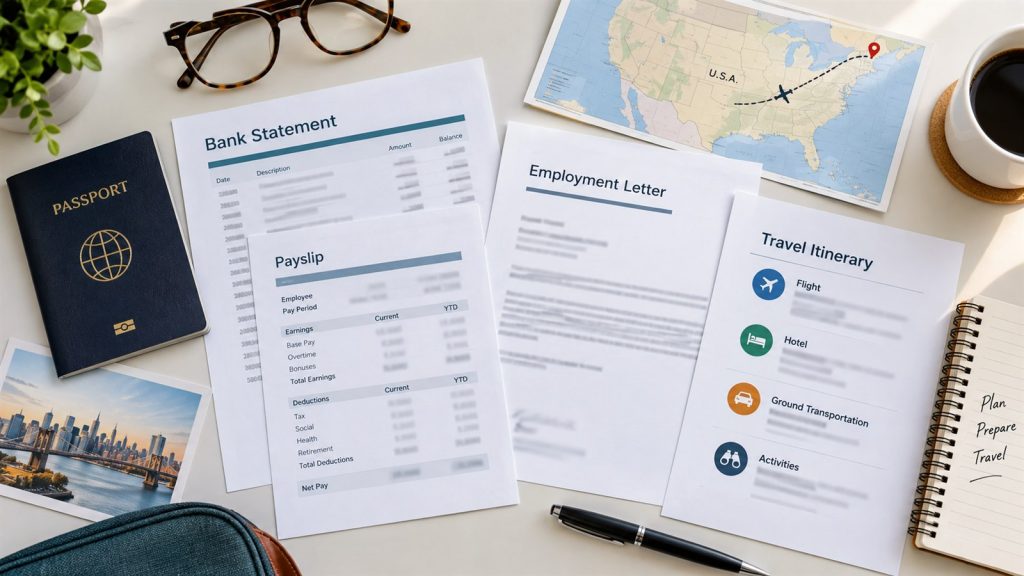
Useful supporting documents include:
- Bank statements covering several months, showing normal activity rather than a single snapshot
- Employment evidence — contract, recent payslips, or a letter confirming your position and approved leave
- Business ownership documents, if you are self-employed — registration, tax filings, business accounts
- Sponsorship evidence, if someone else is paying — who they are, their relationship to you, and their ability to pay
- A realistic travel budget and accommodation details
- Medical insurance for the trip
Bring documents because they explain your situation, not to build a thick folder. Volume does not improve an application; coherence does. An officer who can follow your story in thirty seconds is in a better position to approve it than one working through unexplained paperwork. Our guide on how to prepare documents goes through this in detail.
Why sudden large deposits cause problems
A balance that jumps shortly before the interview raises an obvious question: whose money is it? If the deposit is genuine — a property sale, a bonus, a legitimate transfer from family — be ready to explain it and show where it came from. If you cannot explain it, it works against you, and a topped-up account can weaken a case that would otherwise have been fine.
Steady, ordinary account activity over several months is more persuasive than a large number that appeared last week. We cover the specific mistakes in bank statements for a visitor visa.
Trips for medical treatment
Medical travel is a recognised reason to visit, and it needs stronger financial evidence than an ordinary holiday, because the costs are higher and harder to predict. Be ready to show what the treatment is, roughly what it will cost, who is paying, and how. A letter from the U.S. provider with an estimate, alongside proof that the funds exist, answers the question directly.
Your documents must match your DS-160
The officer reads your DS-160 before you sit down. If the form says you are staying two weeks with a friend and your documents show a two-month hotel booking, the mismatch becomes the subject of the interview. Make the form accurate first, then bring documents that support exactly what it says.
What this means for applicants
Stop asking how much is enough and start asking whether your trip is explainable. Describe a realistic trip, show ordinary finances that comfortably cover it, and make sure every document points the same way. Owning property, earning a particular salary or buying insurance guarantees nothing on its own — each application is decided individually, on its own facts. See also why some applications look weak.
Checklist before the interview
Financial preparation:
Frequently asked questions
How much money do I need in my account?
There is no official minimum. What matters is whether your funds credibly cover the trip you described, and where those funds came from.
Can a relative in the U.S. pay for my trip?
Yes, sponsorship is normal. Document who they are, your relationship, and their ability to cover the stated costs.
Will bringing more documents improve my chances?
No. More paper does not equal a stronger case. Relevant, consistent documents that match your DS-160 are what help.
Does owning property guarantee approval?
No single factor guarantees anything. Property is one piece of a wider picture that the officer weighs as a whole.
Can using U.S. public benefits affect my visa?
Improperly receiving certain public benefits can lead to visa revocation or future ineligibility. Check the official guidance before accepting any assistance while in the United States.
Conclusion
Financial preparation for a B1/B2 visa is not about hitting a number. It is about presenting a trip you can plainly afford, with money whose origin you can explain, and documents that agree with your application. Do that and the financial question stops being the difficult part of the interview.
How EasyVisaPath can help
EasyVisaPath is an independent visa-support service. We help you build a realistic trip budget, organise financial evidence, and make sure your documents and DS-160 tell the same story. Learn more about our support.
Disclaimer
EasyVisaPath is an independent visa-support service and is not affiliated with the U.S. Department of State or any U.S. government agency. Visa decisions are made exclusively by U.S. consular officers. This article provides general information and does not constitute legal advice.